Last month I participated in an informal meeting for users and developers of the Phenotype and Trait Ontology (PATO), organized by Chris Mungall and Suzanna Lewis at the Lawrence Berkeley National Labs in Berkeley, California. PATO is the quality ontology used by many in the OBO community to annotate phenotypic variation. We are heavy-duty PATO users here at Phenoscape, so I was eager to meet with its developers and other users to discuss outstanding issues and hear about phenotype annotation from other projects. Read the rest of this entry »
PATO Users Meeting
November 20, 2009
 Leave a Comment » |
  Data Curation |
  Permalink
 Posted by wdahdul
Beta release of the Phenoscape Knowledgebase
October 12, 2009We are pleased to announce the beta release of the Phenoscape Knowledgebase (KB) at http://kb.phenoscape.org/ and would like to solicit feedback.
Phenoscape KB integrates phenotypic data from genetic studies of zebrafish with evolutionarily variable phenotypes from the literature of fishes. It currently contains 333,987 phenotype statements about 2,310 taxa (mainly ostariophysan fishes), from 51 publications, and 11,267 phenotype statements about 2,953 genes retrieved from ZFIN (zfin.org). You can explore these data by searching for anatomical terms, taxa (by Latin name), or genes (by ZFIN gene symbol). Read the rest of this entry »
Leave a Comment » | Informatics, Knowledge Base, Science, Software | Tagged: knowledgebase | Permalink
Posted by tjvision
Our summer of code project
August 27, 2009Phenoscape has mentored, under the auspices of NESCent, another Google Summer of Code student this year. Kasia Hayden developed a plugin package for Mesquite that allows users to view character matrices and EQ (ontology-based) annotations produced using the Phenex tool. The primary purpose was to allow curators to share their annotation work with others in the context of a more familiar tool. Users can select cells in a Mesquite character matrix and, using two new cell tools, see EQ annotations either as text in the bottom pane of the matrix window, or as a graph in a separate pop-up window. Read the rest of this entry »
Leave a Comment » | Informatics, Phenex, Software, Source Code | Permalink
Posted by pmidford
Summer Curation Drive
August 24, 2009On March 29, 2009, we initiated an ambitious goal (informally dubbed the ‘5K Karacters Kuration Goal’) to curate over 5,000 characters for 3,500 species from 50 papers by June 15. The reason for this annotation push was the planned beta release of the Phenoscape Knowledgebase at the Joint Meeting of Ichthyologists and Herpetologists (22-27 July 2009) in Portland, Oregon. We formed a curator team including Jeff Engeman, Terry Grande, Eric Hilton, John Lundberg, and Paula Mabee, and we each took on a significant chunk (either 500 or 1000 characters) of the ichthyological literature. Read the rest of this entry »
Leave a Comment » | Anatomy Ontology, Data Curation | Permalink
Posted by wdahdul
New fossil tells how piranhas got their teeth
August 16, 2009A recent publication on Megapiranha paranensis from Phenoscape curators Wasila Dahdul and John Lundberg is in the news!
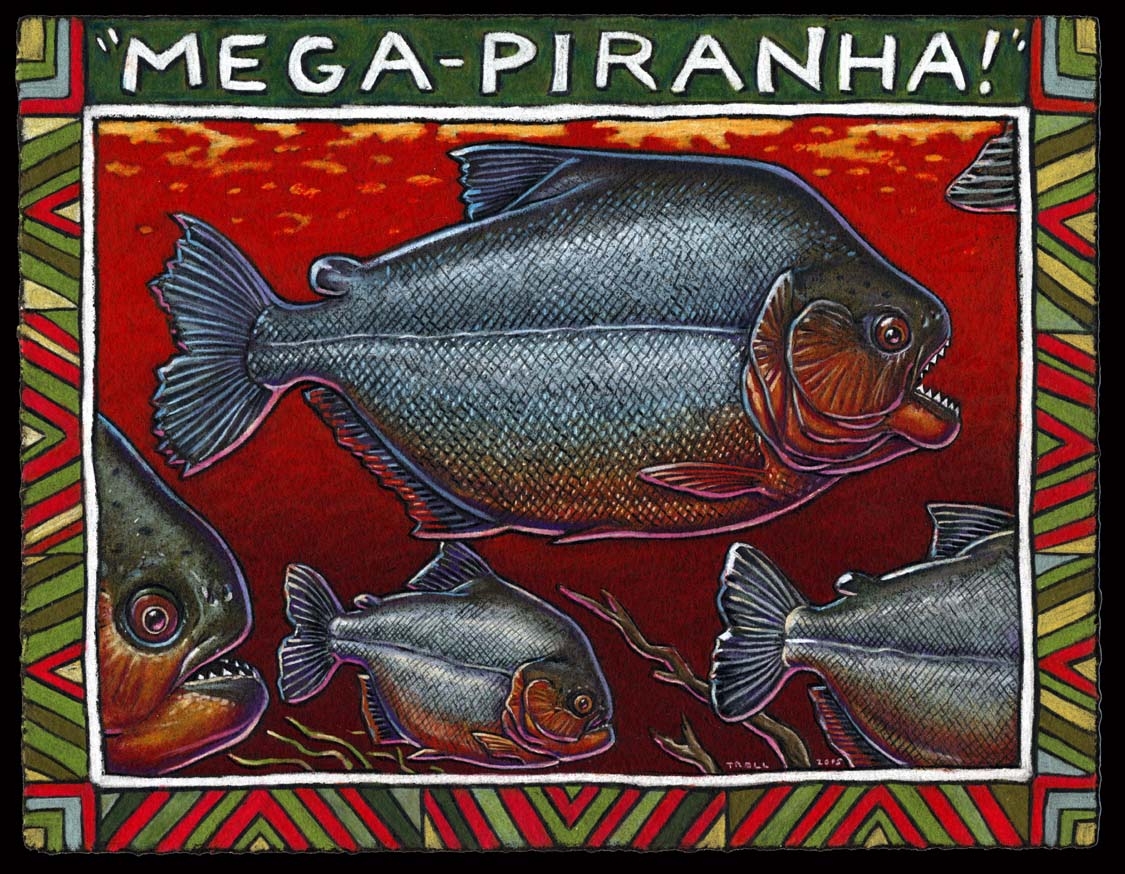
DURHAM, N.C. — How did piranhas — the legendary freshwater fish with the razor bite — get their telltale teeth? Researchers from Argentina, the United States and Venezuela have uncovered the jawbone of a striking transitional fossil that sheds light on this question. Named Megapiranha paranensis, this previously unknown fossil fish bridges the evolutionary gap between flesh-eating piranhas and their plant-eating cousins. Read the rest of this entry »
3 Comments | Data Curation, Morphology, Publications, Science, Teleosts | Permalink
Posted by tjvision
Phenex 1.0-beta24 released
August 14, 2009Phenex 1.0-beta24 is now available for download.
This release has a few new features and a number of bug fixes:
Features:
- The Search panel from OBO-Edit is now available in Phenex, under the View > Ontology menu. This allows the user to do a textual search of all loaded terms, and view a results list.
- There is a “quick editing” mode for the character matrix interface. The user can type the name of a state symbol, without first double-clicking the cell, and Tab or Return to the next cell to edit.
- If the quality “count” has been used in a phenotype for any state for a character, it will be auto-filled for subsequent states.
- Open/Save panel starts at the previously visited directory.
Bugs fixed:
- Copy and paste of terms in the Phenotypes table works consistently now.
- The post-composition editor no longer disappears after tabbing out of the genus field when running on Java 6.
- The menubar no longer disappears after using the post-composition editor.
Leave a Comment » | Curation Tools, Informatics, Phenex | Permalink
Posted by Jim
ICBO Summary
August 12, 2009While the rest of Phenoscape was at ASIH running the ontology workshop and announcing the database and website release, I was across the country, representing Phenoscape at the International Conference on Biomedical Ontologies in Buffalo, NY.
ICBO covered 2-3/4 days (July 24-26) of presentations with two evening poster sessions. There were
also software demos during the lunch breaks, and two panel discussions.
Although there were several sessions devoted to ontologies of disease and clinical practice, there
were a number of talks of interest to Phenoscapers. Among these were several alignment talks, including
one from the BGEE group on Homonto and Chris Mungall’s on cross products and Uberon. There were also sessions
on annotation and natural language processing (NLP), including Mike Bada’s talk on developing a corpus for testing NLP based annotation.
There were also two talks specifically about ontologies and physiology, one by John Gennari focused on integrating
existing anatomy ontologies (e.g., FMA) with physiological simulations, though he specifically ducked ontological
modeling of physiology as process. The other was an ‘old school AI’ simulation of a patient, that includes models of
physiology, cognition, and NLP.
There was also some promising activity on behavior ontologies, including a poster by Tim Beck, a postdoc from the UK on a mammalian behavior ontology
and a ‘behavior lunch’ on the second day, with Tim, Judy Blake, David Shotton (ABO collaborator from Oxford), Mary Shimoyama (RGD), and several others.
There is a European plan to develop a new OWL-based general behavior ontology, and Chris Mungall has recently established an OBO-behavior list ().
There was also a lot of discussion generated by the proposed ontology of homology relations (the 1.0 version; 1.1 released recently(http://bgee.unil.ch/bgee/download/homology_ontology_v1.1.obo)), although the consensus from the numerous people I discussed
it with was that it needed more work (which is happening).
Other interesting ontologies included an ontology of Evolutionary processes presented in a poster by Adam Goldstein (Iona University). He’s since been in
contact with Hilmar, and I believe with representatives of CDAO and Dryad. Phenoscape was also represented by a poster.
There were two panels, one focussing on Ontology and Publishing. Although the lineup, which included
a representative from Elsevier (Jabe Wilson) and Alan Ruttenberg from Science Commons suggested a discussion
on open publishing, the Elsevier representation was quiet restrained, and it was Larry Hunter who made the strongest argument that publishers currently
provide little value to academics. David Shotton discussed his semantic annotation of a randomly selected paper on an infectous disease.
The second panel was on the Future (and past) of ontologies and knowledge representation. I think the two memorable claims from this discussion
were the call to expand the A-box (since the T-box is really less than most people think) and Barry Smith’s claim that in 25 years consulting ontologies
will be as common in biology and medical departements as statisticians are today.
The text from all the presentations and posters will be made available at Nature Proceedings (http://precedings.nature.com/collections/icbo-2009). There was
also an ICBO group on FriendFeed (http://friendfeed.com/icbo) with other attendee’s tweets from the conference and preceeding tutorial sessions. Finally, I will
be posted a more detailed report on my personal blog (http://ontethology.blogspot.com).
While the rest of Phenoscape was at the ASIH meeting, involved with the ontology workshop and the release of the database and website, I was across the country, representing Phenoscape at the International Conference on Biomedical Ontologies (ICBO) in Buffalo, NY. ICBO covered 2-3/4 days (July 24-26) of presentations with two evening poster sessions. There were also software demos during the lunch breaks, and two panel discussions.
Although many of the sessions were devoted to ontologies of disease and clinical practice, there were a number of talks of interest to Phenoscapers. Read the rest of this entry »
2 Comments | Data Curation, Ontology, Workshops | Tagged: Conference, ICBO | Permalink
Posted by pmidford
Postdoctoral opportunity: The genetics and evolution of anatomical diversity in fishes
June 16, 2009An NSF-funded postdoctoral position is available in the laboratory of Monte Westerfield (University of Oregon, Institute of Neuroscience) to study experimentally candidate genes for the diversification of skeletal architecture in fish species related to zebrafish.
The position is available through the Phenoscape project, a collaboration among evolutionary and model organism biologists (including Paula Mabee of the University of South Dakota, Monte Westerfield of the Zebrafish Information Network, and Todd Vision of the National Evolutionary Synthesis Center). Read the rest of this entry »
1 Comment | Jobs | Tagged: Postdoc | Permalink
Posted by tjvision
Joint Phenoscape and AmphibAnat Workshop at ASIH, July 25th in Portland, Oregon
May 28, 2009
Ontologies, controlled vocabularies with well-defined relations among terms, are a key tool in scientific data integration. By using ontologies, scientists from different disciplines can know when they are referring to the same entity by different names, and new discoveries are enabled by computer software being able to reason across disciplines and over large datasets. Already widely used in genomics, ontologies are of growing importance in systematics, ecology, behavior, genetics, morphology and physiology. This workshop aims to explore the utility of ontologies for ichthyology and herpetology, using the Teleost Anatomy Ontology and the Amphibian Anatomy Ontology as case studies of community resources that are being actively developed and used by members of ASIH. Read the rest of this entry »
Leave a Comment » | Workshops | Tagged: AmphibAnat, ASIH, Outreach, Workshops | Permalink
Posted by tjvision
Meeting with Deep Fin and other fishy folk
April 17, 2009Phenoscapers met with Deep Fin and several associated fish groups in late February for ontology development, curation, web interface development and outreach. We had lots of good interactions with the 30+ ichthyologists attending. Read below for the details. Read the rest of this entry »
Leave a Comment » | Workshops | Tagged: Outreach | Permalink
Posted by pmabee


 Phenoscape